FASHVERT
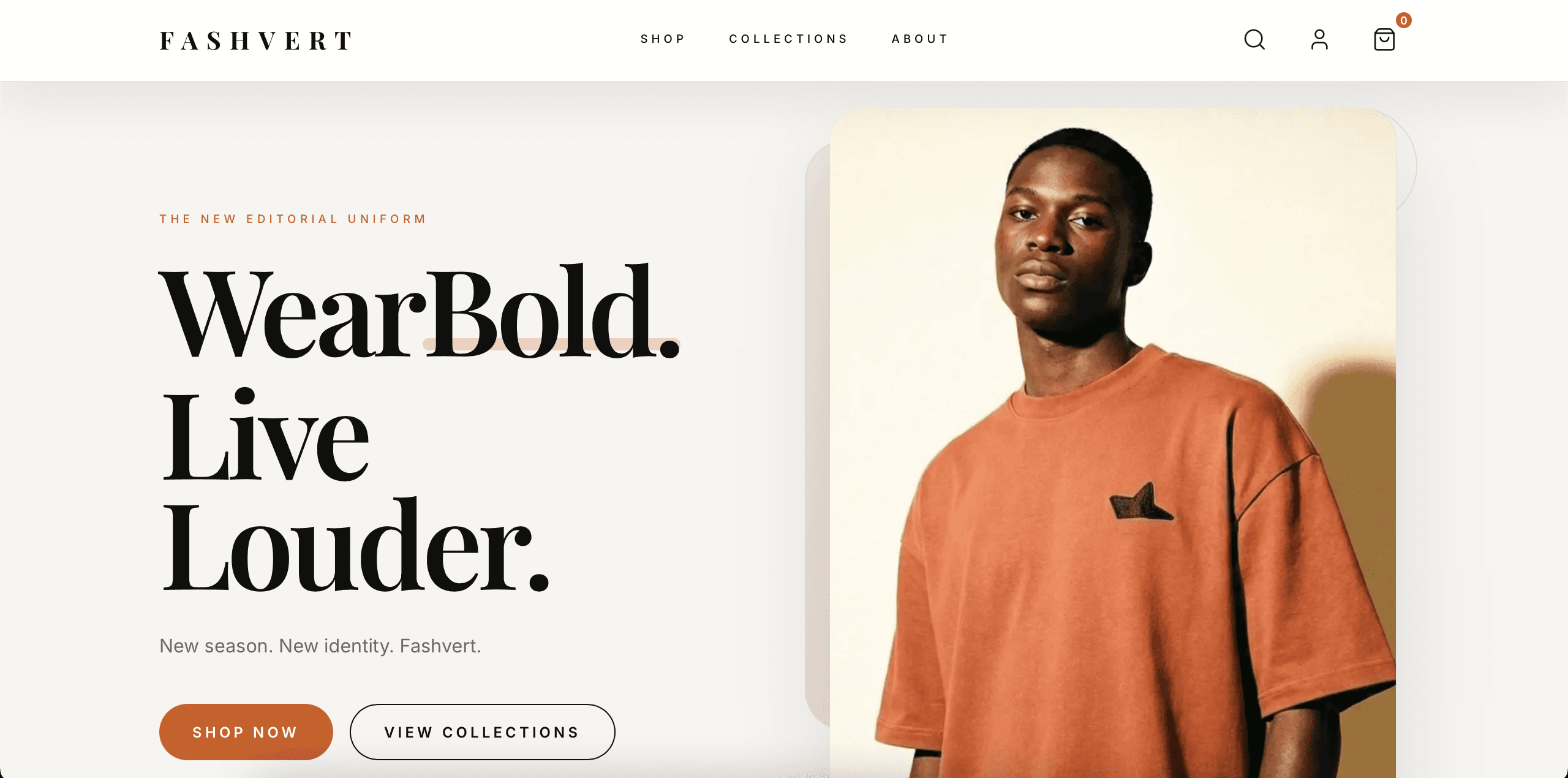
A fashion ecommerce showcase that demonstrates how a premium storefront can balance brand mood, merchandising clarity, and a clean shopping flow.
Why this project mattered.
FASHVERT was built as a concept project to demonstrate a stronger point of view on fashion ecommerce presentation.
The goal was to show how a storefront can feel editorial and premium without becoming harder to shop.
This project mattered because ecommerce work is often judged on product grids alone, when the stronger test is whether brand, browsing, and purchase intent can coexist well.
What was not working.
Many fashion storefronts either feel visually generic or sacrifice usability in the name of mood.
Collection storytelling often gets separated from the actual shopping journey instead of strengthening it.
A useful showcase needed to prove both interface taste and the technical structure behind a scalable ecommerce build.
What success needed to mean.
Show a premium ecommerce direction that feels distinct from template-driven storefronts.
Demonstrate that product discovery can stay intuitive inside a more expressive brand experience.
Prove out a stack that supports content flexibility, client state, and future commerce expansion.
Use the project as portfolio evidence of strengths in ecommerce UX and frontend execution.
What we built.
The solution had to be practical, usable, and aligned with the real business pressure behind the project.
Editorial storefront direction
The experience was shaped around strong headlines, curated sections, and bold visual pacing so the storefront felt intentional rather than template-driven.
Structured product discovery
Shop, collection, and category flows were organized to make browsing feel light and confident while still supporting real shopping intent.
Composable content and state architecture
Next.js, Sanity, Zustand, and Supabase were combined to support flexible content updates, responsive cart behavior, and room for broader ecommerce features.
How the work moved.
A stronger outcome comes from a stronger process, not from improvising the whole thing in code.
Discovery
Defined the ecommerce qualities worth showcasing: atmosphere, hierarchy, clarity, and momentum.
UX / flow design
Mapped the journey from first impression to collection browsing to cart-facing actions.
Content architecture
Structured product and collection content so the storefront could support ongoing merchandising without rigid page edits.
Build
Implemented the concept in Next.js with Tailwind, Zustand-driven client state, and connected backend services.
Testing
Reviewed responsiveness, browsing rhythm, and product-scanning clarity across key pages and devices.
Portfolio readiness
Positioned the final result as proof of capability in premium ecommerce design and engineering.
What changed after.
Where exact numbers were not available or public, the case study uses directional outcomes grounded in the product and business context.
The concept shows a clearer brand point of view than a generic catalog layout.
Products, collections, and supporting brand sections work together as one shopping narrative.
The project gives a visible example of ecommerce thinking across both UX and implementation.
What we chose on purpose.
Chose editorial energy over marketplace clutter
The point was to demonstrate how fashion ecommerce can feel premium without collapsing into noise.
Kept the shopping flow simple
A showcase project still had to prove real usability, not just attractive screens.
Built with scalable content in mind
Sanity and the supporting architecture were chosen to show how the concept could grow into a fuller commerce product.
What we would improve next.
Expand the concept with richer product storytelling, product-detail depth, and stronger merchandising experiments.
Add deeper account, order, or retention features to show a more complete ecommerce system.
Introduce analytics-led optimization around collection performance, cart behavior, and conversion flow.
Need an ecommerce site that feels like a brand, not just a catalog?
We build ecommerce experiences that show stronger taste, clearer structure, and cleaner product thinking.